Dutch households can breathe a small sigh of relief in 2026. According to new calculations from ING Research, families with average energy consumption are expected to pay about 4% less for gas and electricity next year compared to 2025. This means the energy bill will turn out more favorably than many had previously thought.
Slight Decrease in Energy Costs #
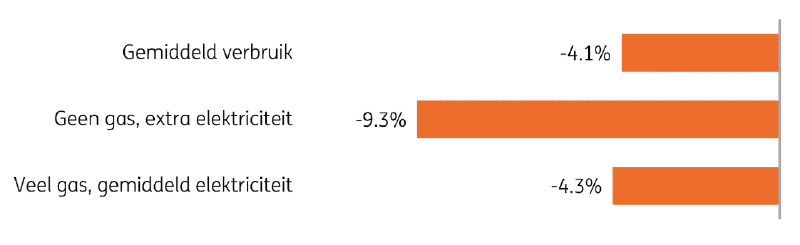
The analysis shows that the so-called energy share—the portion of disposable income spent on energy—will decrease from approximately 4.4% this year to around 4.1% in 2026. While this may seem like a small shift, the percentage primarily reflects the relationship to income. When looking at the actual costs in euros, families will on average pay about 4% less. Thus, the energy share changes only slightly, but the energy bill itself will be noticeably lower due to falling tariffs.
For those who have completely disconnected from gas, the savings are even more significant. These households could see their energy bills drop by as much as 9% in 2026, assuming their consumption remains the same.
Why Are Costs Falling? #
The expected decline is mainly due to lower variable supply rates. These rates move with the market price of energy and have recently fallen, partly because more liquefied natural gas (LNG) is available worldwide. Countries like the United States and Qatar have expanded their export capacity, while Europe has put more import terminals into operation. This has increased supply and stabilized prices.
At the same time, some other components of the energy bill are actually rising. These include higher fixed costs and an increase in the gas tax. However, these additional expenses are largely offset by the lower market prices, resulting in a lower total bill overall.
Savings Won’t Be the Same for Everyone #
The estimates are based on the assumption that households will maintain the same level of energy consumption as this year. Those who consume more, for example by using electric heating or a heat pump more intensively, will find that the savings are smaller or may even be non-existent.
Additionally, families with a fixed energy contract will not benefit immediately. Those who are locked into a contract with high rates well into 2026 will have to wait until the contract ends to take advantage of the new, lower market prices.
Nevertheless, ING sees a slightly downward trend for the majority of households: the energy bill appears set to be a bit friendlier next year than in 2025.