Foto: Shutterstock/Ground Picture
According to the annual trend report from Dutch New Energy Research, major shifts are occurring in the energy market. While the solar panel market has declined significantly due to the end of the net metering scheme, another sector is seeing strong growth.
The Rise of the Home Battery #
An increasing number of households are investing in home batteries. This is mainly because feeding electricity back to the grid is becoming less profitable. The high purchase price means that primarily wealthier households are buying home batteries, although the price has halved in recent years.
An average home battery still costs between €5,000 and €10,000, excluding installation. However, there is now a simpler solution: the plug-in battery. You just plug it into a wall outlet. They store less energy and don’t require professional installation, costing around €1,500.
This is a logical consequence of abolishing the net metering scheme. When households receive (almost) nothing for their excess generated energy, they naturally want to use it themselves. With solar panels already on their roofs, a home battery becomes an attractive next step.
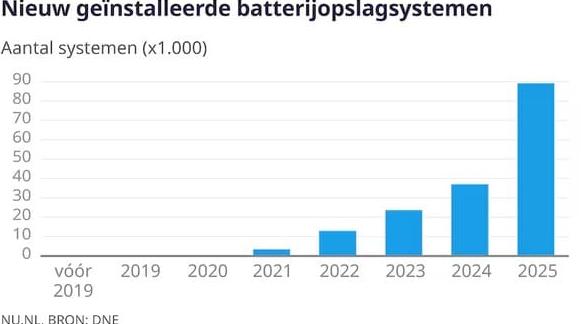
The explosive growth in the number of home batteries is impressive, but in absolute numbers, it’s still relatively small. This is mainly due to the substantial purchase price.
According to Hrvoje Medarac, lead researcher at DNE Research, home battery sales are expected to grow even faster next year. As sales increase, prices will likely start to fall.
Energy professor Martien Visser agrees that choosing a home battery is logical. She notes that it allows you to avoid taxes on electricity drawn from the grid. If you have solar panels and a home battery, you can store the generated solar power for your own use.
End of Net Metering Scheme #
With the net metering scheme ending in 2027, consumers are uncertain about the payback period for solar panels, leading to reduced interest.
However, there is another reason for the declining demand for solar panels: market saturation. 50% of owner-occupied homes already have them. The lagging households are social and private rental properties, which have solar panels in only 25% and 10% of cases, respectively.
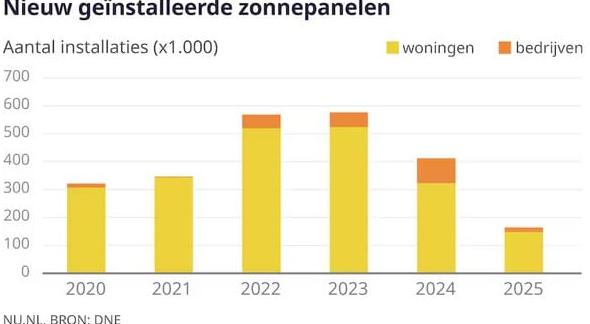
While we see a clear decline, this can also be attributed to partial market saturation, although there is still significant room for growth. Much will also depend on the energy policies of the next government.