

In the last century, teachers commanded significant respect and held a high-status position in society. This began to change towards the end of the twentieth century as wages failed to keep pace. Now, an effort is underway to catch up, which is urgently needed given the current teacher shortage.
The profession of a primary or secondary school teacher ranks among the top ten most stressful jobs. Primary school teachers even take the second spot, just behind pharmacy assistants. Many employees in these fields are pessimistic about the future of their work. Furthermore, they report higher rates of absenteeism and often feel that not enough is being done to address stressful working conditions.
Fortunately, there is good news for the education sector. Teachers’ salaries are set to rise significantly in the coming years.
Significant Salary Increases for Teachers #
Increasing teacher salaries is expected to boost the profession’s status and contribute to an improvement in education quality. The FNV trade union secured the backing of 92% of its members for the new collective labor agreement (CAO) for secondary education.
Spread over two years, teachers will receive a 5.8% wage increase. Their salaries will rise by 4.6% retroactively from November 1, 2025. An additional 1.2% will be added next year. The salary scales have also been published. Teachers without extra duties will be placed in the basic LB scale. While starting salaries across different roles are similar, the differences become more pronounced as a teacher advances up the scale.
Understanding the New Salary Scales #
Other scales are designated LC, LD, and LE. Experienced teachers who serve as mentors or have additional responsibilities may be eligible for the LC or LD scales. Teachers in subjects experiencing shortages, such as Dutch or German, may also be placed in a higher scale. For subjects with a surplus of teachers, like history or social studies, placement is typically in the LB scale.
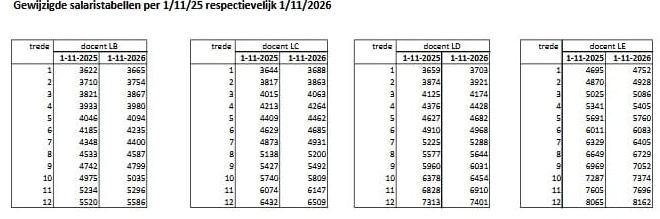
As seen in the table above, the first three types of positions start at similar wage levels. However, after several increments, the salaries diverge significantly. The LE (Teacher-Educator) role is a position in primary education involving complex tasks, such as mentoring other teachers, developing internal training, and coordinating educational programs. This role starts at a relatively high salary.
Reducing Workload #
A key focus of the new CAO is reducing workload. The maximum number of teaching hours will be reduced from 750 to 720 hours per year. This equates to 18 classroom hours per week. However, this is supplemented by a substantial number of hours for lesson preparation, grading homework, administrative tasks, and meetings.
The agreement also includes other benefits, such as increased travel expense reimbursement, reduced student debt, and more equal treatment for all teachers.