

A new phishing campaign is targeting Dutch crypto holders with a fake tax form designed to harvest personal and address information, with authorities warning it could be a precursor to physical robberies. Cybercriminals are sending emails that appear to be from the Dutch Tax and Customs Administration (Belastingdienst), urging recipients to fill out a so-called ‘crypto declaration form’.
Fake Tax Form #
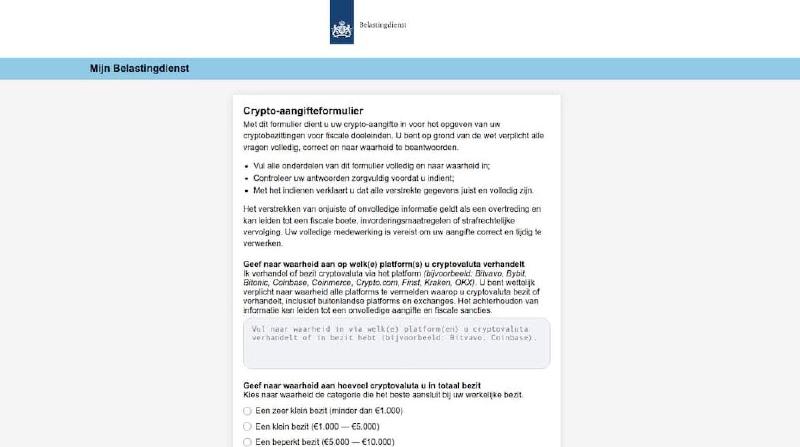
Cybercriminals are currently running a campaign to obtain the details of Dutch crypto holders, reports RTL. Victims receive an email from the ‘Tax and Customs Administration’ with a call to fill out a supposed ‘crypto declaration form’.
The page looks authentic, with a clean layout, serious text, and an official logo at the top. However, behind the fake form are shady intentions, with risks of fraud or even robberies and kidnappings. Do not fill it out!
The fake form asks people to fill in how much crypto they own and on which exchanges their coins are held. It also requests personal information and address details.
Hardware Wallets, Robberies, and Kidnappings #
People who fill out the form could become targets for the criminals. “It’s possible that criminals will contact you by phone afterwards,” says cybersecurity expert Wesley Neelen, who discovered the fake form:
“But they could also show up at your door.”
The fake form specifically asks whether the user has a hardware wallet. This is a device for storing crypto at home. People who indicate they use hardware wallets are at particularly high risk, as the criminals behind the fake form could decide to commit a robbery or even kidnapping to steal the hardware wallet and crypto.
The criminals may be specifically looking for owners of hardware wallets from the manufacturer Ledger. In 2020, this manufacturer was hacked, resulting in the theft of email addresses of thousands of customers who had purchased hardware wallets. Since then, Ledger owners are frequently approached by scammers via phone or email.
Rising Crypto Robberies and Kidnappings #
The concerns are real, as the number of crypto-related robberies and kidnappings is increasing worldwide. For example, police arrested five suspects earlier this month who were allegedly involved in the kidnapping of a 24-year-old man. The man was forced at gunpoint to transfer his crypto.
The number of violent crypto robberies is also growing explosively in other countries. Earlier this year, there were reports of violent crypto robberies and kidnappings in Brazil, France, the United States, Canada, and Australia.
According to Alena Vranova, founder of SatoshiLabs, at least one crypto holder is kidnapped worldwide every week.